


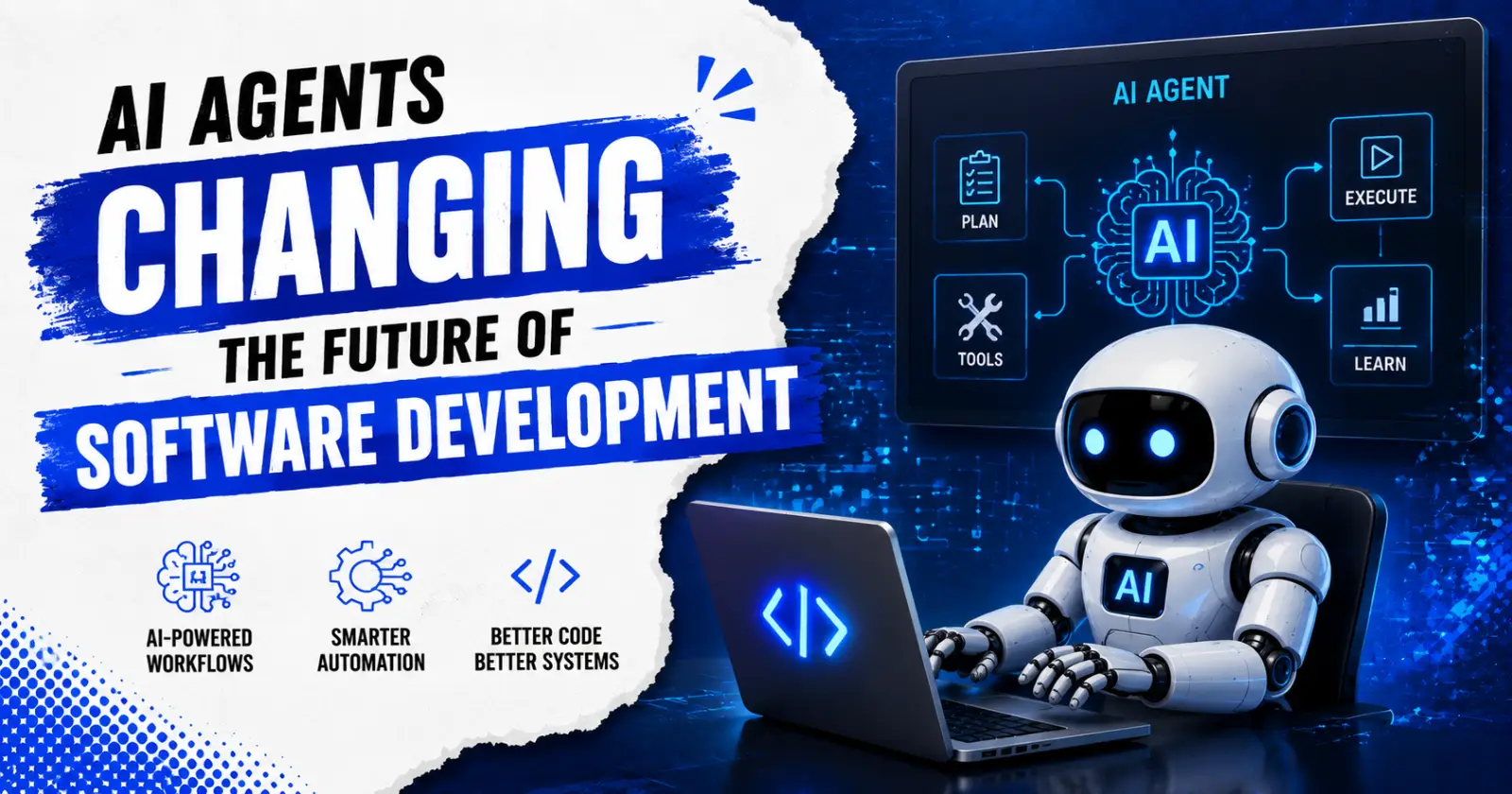
Artificial intelligence is moving beyond tools that simply generate code or answer developer queries. AI agents can now plan tasks, use tools, retrieve information, execute actions, and work through multi-step software workflows.
This is changing how software is developed. Developers can increasingly delegate repetitive tasks to AI while focusing more on architecture, system design, problem-solving, testing, and decision-making.
As AI agents become more capable, understanding how to design, integrate, and manage these systems is becoming an important part of modern software development.
So, how exactly are AI agents changing the way software is built?
What Are AI Agents?
A traditional software application generally follows instructions that developers explicitly define.
An AI agent works differently.
Instead of simply responding to a single instruction, an agent can be designed to:
- Understand a goal
- Break the goal into smaller tasks
- Decide what actions are required
- Use tools or APIs
- Retrieve information
- Evaluate intermediate results
- Adjust its approach
- Complete the task
For example, a traditional customer-support application might retrieve information from a database and display it to the user.
An AI agent could understand the customer’s problem, search a knowledge base, check account information, determine whether a refund is appropriate, call an internal API, update the customer’s record, and provide a response.
The important difference is action.
Generative AI primarily focuses on producing content. Agentic AI extends this capability by connecting intelligence with tools, workflows, memory, and execution.
1. Developers Will Move From Writing Code to Designing Systems
AI coding assistants can already generate functions, explain code, suggest fixes, and help developers work through programming problems. As AI agents become more capable, the developer’s role can expand beyond writing individual functions.
Instead of manually implementing every step of a workflow, developers may increasingly define:
- System architecture
- Agent roles
- Tools and APIs
- Data sources
- Workflow logic
- Memory mechanisms
- Evaluation criteria
- Security controls
- Human approval points
This does not mean developers will stop coding.
Rather, coding becomes one part of a broader engineering process.
The developer increasingly becomes the person responsible for designing the environment in which AI can safely and effectively perform tasks.
2. Software Development Becomes More Goal-Oriented
Traditional programming is largely instruction-oriented. A developer defines what the system should do and how it should do it. Agentic systems introduce a more goal-oriented approach.
A developer might define an objective such as:
“Analyse these customer complaints, identify recurring issues, classify their severity, and create a summary for the product team.”
An agent can then determine a sequence of actions required to accomplish that objective.
This creates an important change in development thinking.
Developers need to understand not only how to implement functionality, but also how to translate business objectives into workflows that AI systems can execute.
That requires skills in task decomposition, planning, tool selection, state management, and system design.
3. AI Agents Can Automate Multi-Step Development Tasks
One of the most significant changes is the ability of agents to handle workflows rather than isolated tasks. Consider a software-development workflow.
A developer might traditionally need to:
- Understand a feature request
- Search the existing codebase
- Identify relevant files
- Write code
- Run tests
- Debug failures
- Update documentation
- Prepare a pull request
An agentic workflow can potentially coordinate several of these steps.
The developer can provide the objective and constraints while the AI system analyses the repository, proposes changes, generates code, runs tests, identifies errors, and iterates.
Human review remains important, particularly for production systems. But the amount of manual effort required for repetitive development work can decrease.
This is one reason AI coding systems are evolving rapidly toward agent-based workflows rather than remaining simple code-completion tools.
4. Multi-Agent Systems Could Divide Complex Work
Not every problem needs a single AI agent. Complex workflows can be divided among multiple specialised agents, with each agent handling a specific responsibility.
For example, a software development system could have:
- Planning Agent: Breaks a feature request into technical tasks.
- Coding Agent: Implements the required changes.
- Testing Agent: Creates and executes tests.
- Code Review Agent: Analyses the implementation for potential problems.
- Documentation Agent: Updates technical documentation.
These agents can communicate with one another and pass information through a shared workflow.
This concept is known as a multi-agent system.
The advantage is specialisation. Instead of asking one AI system to perform every task, developers can design a system in which different agents have clearly defined responsibilities.
However, this also introduces new engineering challenges around coordination, state management, error handling, and evaluation.
5. Software Architecture Will Need to Account for AI Behaviour
Traditional software architecture is largely deterministic.
If a function receives a particular input, developers generally know what output to expect.
AI systems are different.
An agent can make decisions based on context, retrieved information, model behaviour, and previous actions.
That means software architects need to think about new architectural components such as:
- Agent orchestration
- Memory
- Tool calling
- Retrieval-Augmented Generation (RAG)
- Model selection
- State management
- Observability
- Guardrails
- Human-in-the-loop workflows
This is where AI system design becomes particularly important.
Building an agent is not simply a matter of connecting an LLM to an API. The system needs an architecture that determines what the agent can access, what it can do, what information it remembers, and what happens when something goes wrong.
6. Developers Will Need to Work With Tools, APIs, and External Data
An AI agent becomes significantly more useful when it can interact with the world outside the model.
For example, an agent might need to:
- Search a knowledge base
- Query a database
- Call a REST API
- Read a document
- Execute Python code
- Retrieve information from a website
- Send an email
- Update a CRM
- Trigger another software workflow
This is commonly enabled through tool calling or function calling.
For developers, this means understanding how AI systems connect with existing software becomes increasingly important.
The future of AI development is therefore not just about building better models. It is also about building reliable interfaces between models and the software, data, and tools they need to use.
7. RAG Will Become an Important Part of Enterprise AI
Large language models have broad knowledge, but enterprise applications often need access to private and continuously changing information.
This is where Retrieval-Augmented Generation (RAG) becomes useful.
A RAG system can retrieve relevant information from a company’s documents, databases, or knowledge repositories and provide that context to an AI model before generating a response.
When combined with agents, RAG becomes even more powerful.
An agent could determine what information it needs, retrieve the relevant documents, reason over the information, and use the results to complete a task.
For developers, this creates a need to understand:
- Embeddings
- Vector databases
- Retrieval strategies
- Document processing
- Context management
- RAG pipelines
- Evaluation
These capabilities are becoming important building blocks for production-oriented AI applications.
8. Testing AI Systems Will Become More Complex
Traditional software testing often checks whether an application produces the expected output for a given input.
Agentic systems introduce another layer of complexity. An agent may take several different paths to complete the same task.
It may also produce different responses depending on context, retrieved information, model behaviour, or tool outputs.
As a result, developers need to evaluate not only the final answer but also the behaviour of the system.
This can include evaluating:
- Accuracy
- Tool usage
- Retrieval quality
- Reasoning workflows
- Latency
- Cost
- Reliability
- Safety
- Failure recovery
Observability and tracing therefore become important parts of AI engineering.
The question is no longer simply:
“Did the application work?”
It becomes:
“Why did the agent behave this way, and can we reliably control and improve that behaviour?”
9. Human Oversight Will Remain Essential
The growing autonomy of AI agents does not eliminate the need for developers.
In fact, it creates new responsibilities.
AI agents can make incorrect decisions, misunderstand instructions, use inappropriate tools, or produce unexpected results. More autonomous systems therefore require carefully designed boundaries.
Developers may need to determine:
- Which actions an agent can perform independently
- Which actions require approval
- What data the agent can access
- What tools it can use
- What happens when confidence is low
- How actions are logged
- How failures are detected
- How sensitive operations are restricted
This is particularly important for applications involving financial transactions, healthcare, security, customer data, or other high-impact decisions.
The more autonomous a system becomes, the more important guardrails, monitoring, and governance become.
10. New Software Development Skills Are Emerging
The shift toward agentic software does not mean that traditional programming skills are becoming irrelevant.
Programming, data structures, APIs, databases, system design, testing, and software engineering fundamentals remain important.
But developers increasingly need to add AI-specific capabilities to that foundation.
Some emerging areas include:
- Agent architecture
- Prompt engineering
- Tool and function calling
- RAG
- Vector databases
- Memory architectures
- Multi-agent orchestration
- LLM evaluation
- AI observability
- Model Context Protocol (MCP)
- AI security and guardrails
- Workflow automation
Frameworks such as LangGraph, CrewAI, AutoGen, and DSPy are examples of technologies being used to build and orchestrate modern agentic workflows.
The important point is not to learn every framework.
It is to understand the principles behind agentic system design so that you can adapt as tools and models continue to evolve.
What Will the Software Developer of the Future Look Like?
The future software developer is unlikely to be someone who simply writes code faster than everyone else.
Instead, successful developers may increasingly combine three capabilities:
1. Strong Software Engineering Fundamentals
Understanding programming, databases, APIs, architecture, testing, version control, and deployment.
2. AI Engineering Skills
Understanding LLMs, RAG, agents, tool calling, memory, evaluation, and model behaviour.
3. Systems Thinking
Knowing how to break a complex business problem into components and design reliable systems that combine humans, software, data, and AI.
This combination can make developers significantly more effective in an AI-driven development environment.
How Can Developers Prepare for the Agentic AI Era?
The best way to prepare is not to chase every new AI framework.
Instead, build a strong progression.
Start with programming → understand LLM applications → learn RAG → build AI agents → explore multi-agent systems → learn deployment and observability → build production-oriented projects.
Hands-on development is particularly important.
For example, instead of only learning what an AI agent is, build one that can retrieve information and use tools. Then add memory. Then introduce multiple agents. Finally, evaluate and deploy the system.
This progression helps turn theoretical knowledge into practical engineering capability.
Learning Agentic AI Through Practical System Design
For developers who want to move from experimenting with AI tools to actually designing autonomous AI systems, a structured learning path can be useful.
The Advanced Certification in Agentic AI Systems and Design from Intellipaat is one example of a program built around this transition. Its curriculum covers Modern Python, agent architecture, memory, RAG, tool integration, multi-agent orchestration, AI observability, and production-oriented system design.
The program also uses frameworks such as LangGraph, CrewAI, AutoGen, and DSPy, alongside technologies for vector databases, observability, and workflow automation. Learners work on projects involving autonomous research, multi-agent recruitment, intelligent customer support, and automated content workflows.
The value of this kind of learning path is less about learning one particular framework and more about understanding how the pieces of an agentic system fit together.
As frameworks and models continue to change, that architectural understanding can remain useful even when the underlying tools evolve.
The Future Is Not AI vs Developers
It is easy to frame AI agents as a replacement for software developers.
The more useful way to look at the transition is that AI is changing what developers spend their time doing.
Developers may spend less time on repetitive implementation and more time on:
- Defining problems
- Designing architectures
- Reviewing AI-generated work
- Building agent workflows
- Integrating systems
- Testing AI behaviour
- Managing security and reliability
- Making technical decisions
AI agents can potentially become another layer of abstraction in software development—similar to how frameworks abstracted lower-level programming tasks.
The developers who understand how to work with that abstraction will have an advantage.
Conclusion
AI agents are changing software development from a process where humans explicitly define every step toward one where humans increasingly define goals, constraints, tools, and system architecture while AI handles parts of the execution.
This shift is already visible in AI-powered coding, autonomous workflows, multi-agent systems, and emerging standards for agent-to-agent communication.
But building reliable agentic software requires more than knowing how to use an AI chatbot.
Developers need to understand programming fundamentals, AI models, RAG, tool integration, agent architecture, memory, orchestration, evaluation, observability, and system design.
The future of software development may therefore not belong to people who simply write the most code.
It may belong to those who can design the best systems for humans and AI to build together.
Frequently Asked Questions
1. What is an AI agent in software development?
An AI agent is a software system that can understand a goal, plan tasks, use tools or external data, make decisions, and execute multiple steps to accomplish an objective.
2. How are AI agents different from AI coding assistants?
AI coding assistants typically help with individual development tasks such as generating or explaining code. AI agents can be designed to handle multi-step workflows, such as analysing a codebase, modifying files, running tests, identifying failures, and iterating on a solution.
3. Will AI agents replace software developers?
AI agents are more likely to change the responsibilities of software developers than eliminate the need for developers altogether. Human expertise remains important for architecture, system design, requirements, security, validation, and decision-making.
4. What skills are needed to become an AI agent developer?
Useful skills include Python or another programming language, APIs, LLM fundamentals, RAG, prompt engineering, tool calling, agent architecture, memory, multi-agent orchestration, evaluation, and AI system design.
5. Is RAG important for AI agents?
RAG is useful when agents need access to external or private information. It allows an AI system to retrieve relevant information from knowledge bases, documents, or databases before generating a response or taking an action.
6. What is a multi-agent system?
A multi-agent system uses multiple specialised AI agents that collaborate to complete a larger task. Each agent can have a specific role, such as planning, research, execution, testing, or review.
7. Should software developers learn Agentic AI?
For developers working with AI-powered applications, learning agentic AI can be a useful extension of existing software engineering skills. It can help them understand how to build systems that combine LLMs with tools, data, workflows, and autonomous decision-making.
