


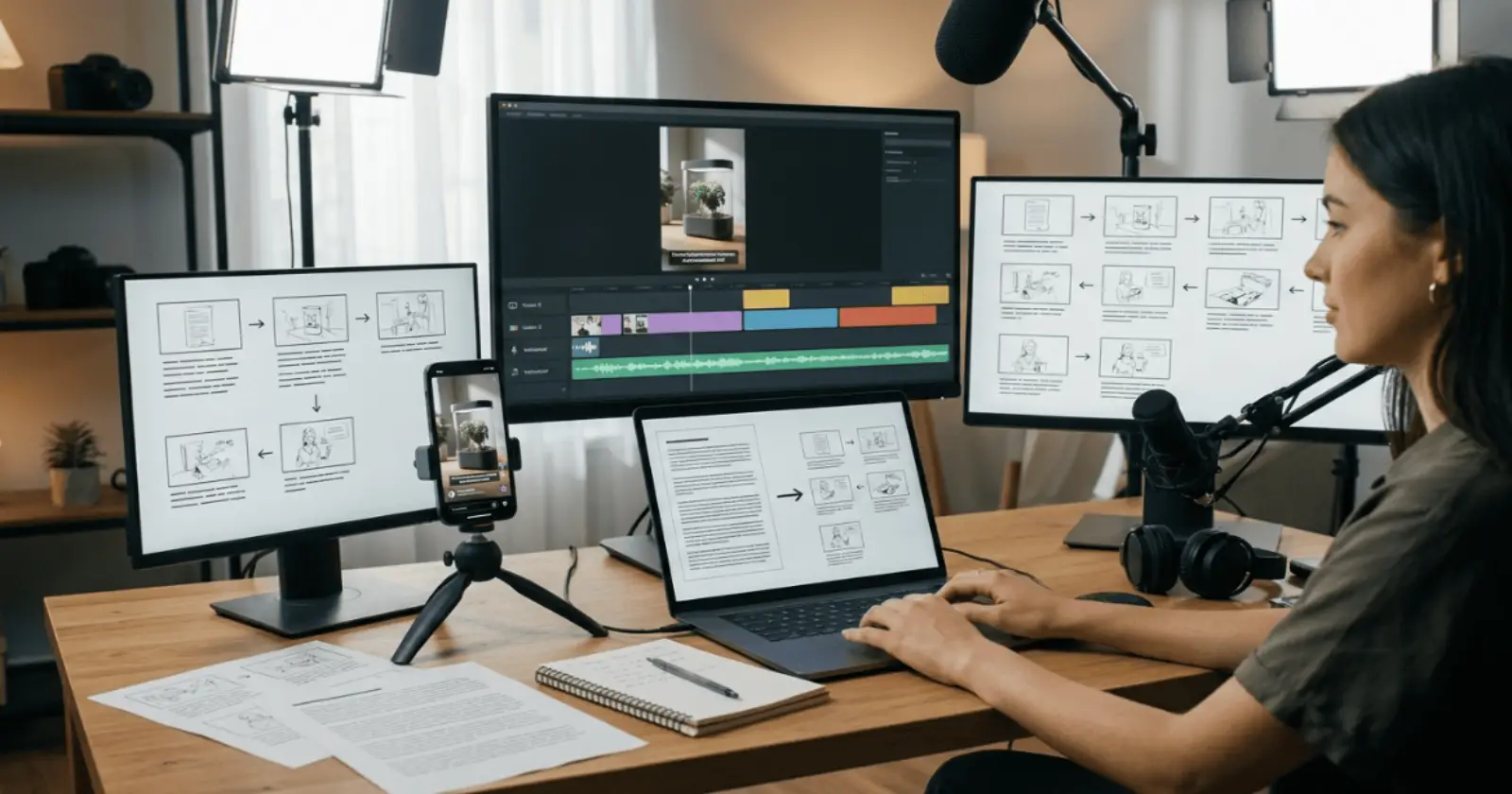
Most people produce considerably more writing than video, and almost none of it ever becomes anything else.
Blog posts that took an afternoon. Newsletter issues nobody reopened. Project work from a course. Explanations typed out in a message because somebody asked. A short story written two years ago. All of it sitting in a folder, finished, and reaching whoever read it the week it went out.
That writing is closer to being a video than it looks, because the hard part is already done. Somebody worked out what the point was, in what order to make it, and where to stop. A script is not a different kind of thinking. It is the same thinking, compressed considerably.
Seedance 2.0, with streamlined production workflows through Higgsfield handles the production half of that conversion, and this covers the other half, which is deciding what survives.
What Have You Already Written That Could Be A Video?
More than you would guess, and the best candidates are rarely the longest pieces.
Anything explaining a single thing works well, and those are the easiest Seedance 2.0 candidates to start with. A post answering one question, a walkthrough of a process, an explanation of why something happens. Those already have a beginning and an end, which is most of what a short video needs.
Personal pieces convert unusually well. Something that happened, something learned, an opinion argued in a paragraph. The material carries its own shape.
Course and project work is worth a look, particularly anything already summarised. A conclusion section is frequently a script with the headings removed.
Short fiction and descriptive writing suit this better than almost anything, because the writing was already doing visual work that a reader was performing in their head.
What converts badly is covered later, and knowing the difference before starting saves an evening.
Why is a Blog Post Not a Script?
Because reading and listening have different tolerances, and the gap is larger than people expect.
A reader controls pace, which is why a post handed straight to Seedance 2.0 as a script rarely works. They can slow down, reread a clause, skip a paragraph, or stop and come back. Writing can therefore carry subordinate clauses, parenthetical asides, and sentences that unfold across three lines, because the reader is managing the flow.
A listener controls nothing. The words arrive at a fixed speed in a fixed order, and anything requiring a second pass is simply lost. That means shorter sentences, one idea at a time, and no structure that depends on the audience holding something in mind while a qualification arrives.
There is also a length problem that surprises everybody the first time. A thousand-word post is roughly seven minutes spoken, which is far longer than anybody will watch for something they did not seek out. The conversion is not a reformatting job. It is a reduction.
How Much of The Writing Actually Survives?
Less than ten percent, usually, and that is the correct outcome rather than a failure.
Seedance 2.0 produces fifteen seconds in a single continuous pass, which is around forty words spoken. A longer piece can be built from several of those, but the working unit is short.
So a thousand-word post becomes somewhere between forty and a hundred and twenty words total. The exercise is identifying which single point the piece was actually making, and saying only that.
This is uncomfortable for anybody attached to their own writing, and it is also clarifying. Most posts contain one idea and a great deal of supporting material, and being forced to find the idea usually improves how the writer understands their own work.
A useful test: if somebody asked what the piece was about and you had ten seconds to answer, what would you say? That answer is the script.
What Does Spoken Rhythm Require?
Reading it aloud, which is the only reliable method and the one people skip.
Sentences that look fine on a screen frequently sound wrong. Long noun phrases stack awkwardly. Words that are unambiguous in print become confusing when heard, particularly homophones. Lists of more than three items lose the listener at the fourth.
The practical approach is to write the script, read it out at normal speed, and rewrite anything that made you stumble before it reaches Seedance 2.0. If the writer stumbles, the listener would have too.
Contractions help. Written prose that avoids them sounds formal when spoken, and formality reads as distance in a short video.
And the first sentence carries disproportionate weight. It has to establish the subject fast enough that somebody scrolling decides to stay, which is a different job from a written opening that can afford to set a scene.
What Does Seedance 2.0 Produce from a Short Script?
A finished clip rather than silent footage, which is the part that matters here.
Seedance 2.0 generates audio in the same pass as the picture, across more than ten languages, with mouth movement matched to the speech. That means the script becomes a narrated video rather than something requiring a separate recording and sync step.
Fifteen seconds in one continuous generation keeps everything consistent within the clip. The setting, the lighting and any subject stay stable, rather than shifting the way stitched segments do.
It accepts up to twelve reference inputs, covering images, clips, and audio, which is how the output gets anchored to something specific rather than arriving generically.
And it produces the aspect ratios a short video actually needs, vertical for phones and standard for anywhere else, which matters because most of these end up on a feed.
Why Do Reference Images Matter More Than the Description?
Because a description produces something plausible and a reference produces something particular.
This is the single most useful thing to understand about working with Seedance 2.0. Written instructions set the scene. Reference material decides what is actually in it.
If the writing is about a place you know, supply photographs of that place. If it concerns a product, an object or a person who has agreed, supply those. If it is about your own work, your own garden, your own city, use what you have on your phone.
The difference in output is not subtle. A generic street and your street are different videos, and the second one is the reason to do this at all rather than using stock.
For descriptive or fictional writing the same principle applies differently. Supply references that establish the mood, the palette and the era rather than the literal subject, and the result stays coherent with what the writing was doing.
How Does One Piece of Writing Become Several Clips?
By finding its natural joints, which most writing has whether or not the writer put them there deliberately.
A post explaining three things is three Seedance 2.0 clips. A story with a setup, a turn and an ending is three clips. A walkthrough with four steps is four.
Each one is a separate Seedance 2.0 generation of around fifteen seconds, and each should work alone, because on a feed they frequently will be seen alone.
Producing them as a set rather than as a sequence is the better instinct. Somebody encountering the second clip without the first should still get something, and if that is impossible the division is in the wrong place.
The sequence then exists for anybody who wants it, and the individual pieces do the work of finding an audience.
What Happens After the First Few Clips?
Something worth planning for, because the second stage is where this stops being an experiment.
An archive of writing converts into an archive of video, and the rate accelerates. The first clip involves working out the script discipline, the reference habit and what a usable result looks like. By the fifth, the script takes ten minutes and the Seedance 2.0 generation takes a few more.
That changes what is worth attempting. A blogger with four years of posts has a library rather than a project, and the sensible approach is a steady rate rather than a conversion push. Two clips a week from existing material is sustainable and produces a hundred in a year.
A pattern worth adopting is converting the older posts rather than the newest ones. Recent writing still has an audience through its original channel. Something published three years ago has stopped working entirely, and a video version gives it a second life in a format the original readers never had.
Keeping the material organised matters more at this stage than at the start. Higgsfield holding the references, the saved wording and the previous attempts by project is what prevents the twentieth clip from being as slow as the first, and what makes a consistent look across a year of output achievable rather than aspirational.
The other thing that emerges is a feedback loop into the writing itself. Anybody converting their own posts regularly starts writing with more structure, because the reduction exercise makes the absence of a clear point obvious.
What Does Higgsfield Keep Between Attempts?
Everything that would otherwise be retyped, which is what makes a second video faster than a first.
Higgsfield is an AI creative suite, meaning the generation, the adjustments and the export sit in one place rather than across separate tools. For this particular workflow, three things about that matter.
The references stay with the project. Photographs supplied once are available for every clip in a set, which is what allows four clips from one post to look like they belong together.
The wording that worked is saved. Output varies between runs, and when a generation comes back right, the description that produced it is the valuable thing rather than the clip itself. Reproducing it from memory does not work.
And the attempts stay side by side. Generating three and choosing is normal practice rather than indecision, and comparing them is only practical if they are visible together.
Beyond that, Higgsfield produces the aspect ratios from one approved clip and runs in a browser, which for somebody converting a blog archive on a Sunday evening removes any setup question.
Which Writing Should Stay Written?
Some of it, and recognising which saves disappointment.
Anything reference based belongs in text. A list of specifications, a comparison table, a set of instructions somebody will follow while doing something else. People need to scan and return to that material, and video makes both impossible.
Anything requiring precision should stay written too, particularly where a reader needs to copy something exactly.
Long argument does not convert. A piece building a case across several stages needs the reader to hold earlier points in mind, and short video cannot support that.
And anything factual you cannot verify should not become a confident narrated Seedance 2.0 clip, because the format lends authority the content may not have earned.
What converts well is anything with a shape: one idea, a story, a process, an explanation of why something is the way it is.
How Would the First One Go?
An hour, and the writing part takes most of it.
Pick something you wrote that you still like, ideally under a thousand words and about one thing.
Write down what it was actually about in one sentence. That sentence is the spine.
Build a script of around forty words around it, and read the script aloud. Rewrite whatever made you stumble.
Gather two or three reference images for Seedance 2.0, from your own photographs if the subject allows it.
Generate three versions in Seedance 2.0 and pick the one that works, rather than accepting the first.
Export vertical, post it, and keep the wording that produced the version you chose.
Then do a second one from the same piece, covering a different point, because the second takes a fraction of the time and that is when the process starts being worth it.
Conclusion
The writing already did the difficult part. Somebody worked out what the point was and where to stop, which is the same problem a script solves and the reason a blog post is closer to a video than it appears.
What remains is reduction and production. The reduction is yours, and it is clarifying rather than painful. The production is what Seedance 2.0 handles, with Higgsfield holding the references and the wording so the fourth clip costs a fraction of the first.
Pick something you wrote and still like. Find the sentence it was actually about. Everything else follows from there.
