


Educational websites have evolved far beyond static pages with course descriptions and downloadable PDFs. In 2026, an effective educational website functions as a full digital learning environment that supports engagement, personalization, accessibility, and long-term scalability. As expectations continue to rise, many organizations rely on teams offering education app development services to ensure their platforms meet modern technical standards while addressing real educational needs.
Learners currently assess educational platforms against their favorite digital products as opposed to comparing them against traditional (historic) schools. With this immersion in streaming media applications, productivity tools and mobile applications, users have changed how they expect to access content. Because of this, educational websites must, at a minimum, combine an appropriate pedagogical framework with an appropriate level of product usability.
This article explores how to build an effective educational website in 2026, focusing on strategy, design, technology, and long-term sustainability.
Why Educational Websites Require a Different Mindset
Education sites operate with constraints that regular marketing and content sites do not have. They have to support stated education goals, multiple user roles, administrative requirements, and often comply with government regulations.
Sixty percent of educators say they do not believe that simply creating a site is enough to meet their needs; they expect it to function like an operational system where they can do teaching and learning, assessment, and communication. Therefore, how well the site is planned and developed will affect the degree of user engagement, user retention, and ultimately user trust in an educational site.
Key differences include multiple audiences with different goals, long-term usage rather than one-time visits, high expectations around accessibility and inclusivity, and sensitive data handling.
Understanding these constraints early helps avoid common mistakes, such as overloading the platform with features or prioritizing visual design over learning flow.
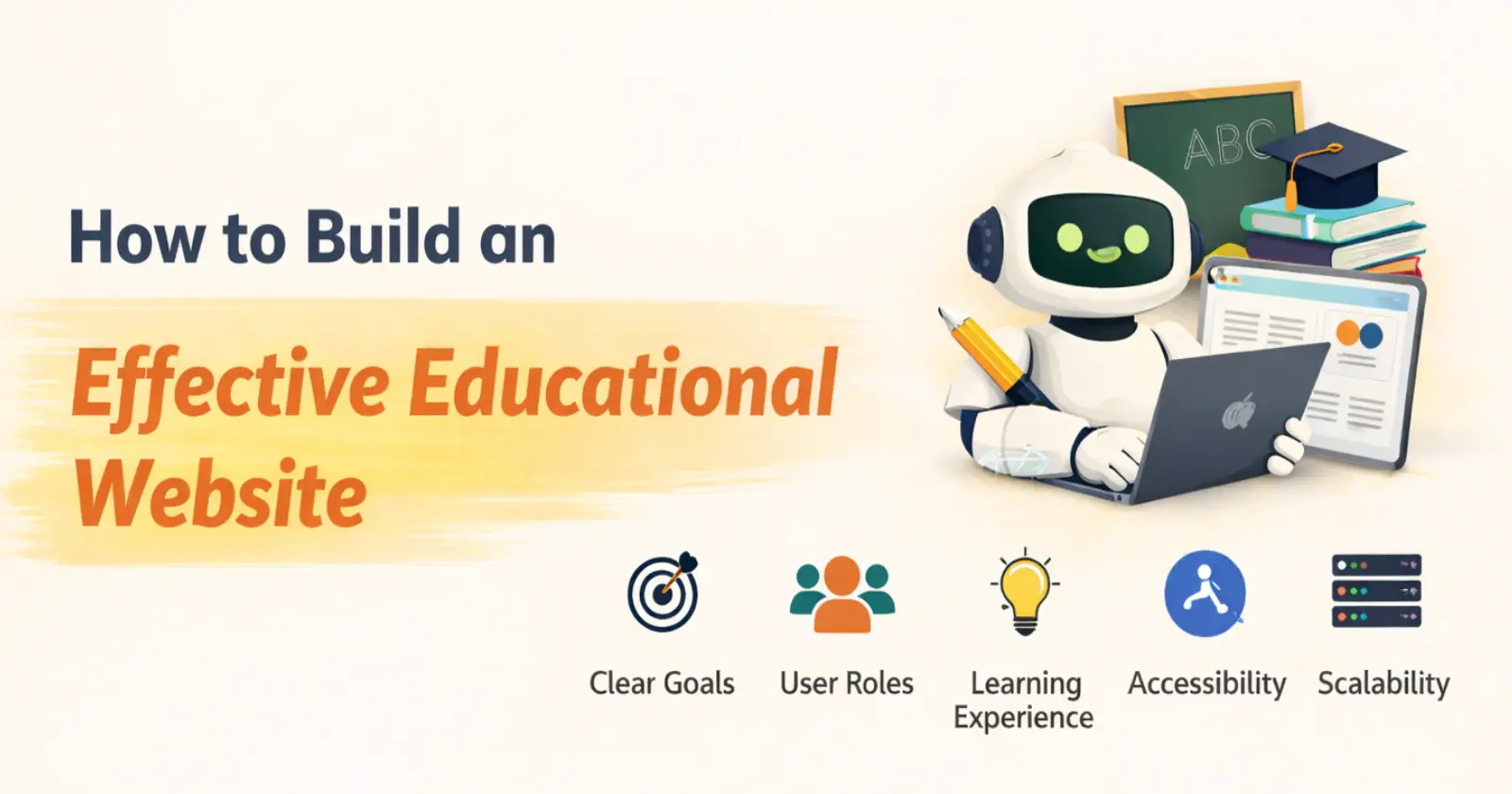
Define Clear Goals Before Choosing Technology
A common failure point of educational websites is their lack of clearly defined goals. Without a goal defining the specific purpose of the platform, these sites develop incorrectly, resulting in complicated sites that produce a negative experience for users.
Clearly identify the intended audience and what will determine the success or failure of the learner/educator on the platform prior to proceeding with any design or development work. Understand what type of learning the platform is intended to support (formal education, continuing/professional training, and/or informal learning) and how your website will grow as time goes by.
Building a website to support a small training provider will be vastly different than building one for an academic institution or corporate learning environment. Clearly defined goals will help you prioritize the features for implementation as well as make architectural decisions on your website.
Design for Multiple User Roles from the Start
Educational websites rarely serve a single type of user. At a minimum, most platforms need to support learners, educators, and administrators. Each group interacts with the system differently and has unique expectations.
Learners focus on clear learning paths, progress tracking, and feedback that keeps them motivated. Educators need tools for content creation, assessment, and visibility into learner performance. Administrators require user management, reporting, and oversight of compliance and data integrity.
Designing separate but consistent interfaces for each role improves usability and reduces friction. Role-based access should be embedded in the platform architecture rather than added later.
Prioritize Learning Experience Over Visual Trends
While contemporary styles are important, the most effective educational sites will use clear/usable data as their #1 priority, rather than relying on the latest trends in design. Complex sites, with too many animations, and/or unique navigation designs all serve to distract from the goal of the site – to help students learn. Creating a strong learning-based user experience is achieved through having predictable navigation, clear next steps, offering an easy-to-follow layout across courses and modules, and keeping cognitive load to a minimum.
A great educational website will provide students with everything they need in order to focus on learning rather than on how to use the site.
Build Accessibility into the Core Experience
Accessibility is both a legal requirement in many regions and a fundamental part of inclusive education. In 2026, accessibility should be treated as a baseline rather than an optional enhancement.
Effective educational websites support screen readers, keyboard navigation, adjustable text size and contrast, captioned multimedia content, and clear, simple language.
Designing with accessibility in mind improves usability for all users and helps future-proof the platform against regulatory changes.
Choose a Scalable and Maintainable Architecture
Many educational platforms evolve after their initial release. Features, users, integrations, and courses are commonly added to educational platforms after they have launched. Therefore, a solid and flexible technical foundation is key to supporting an evolving educational platform.
When building out your educational platform, consider the following elements from a technical architecture standpoint: Good modular backend; API first approach for integration; Cloud infrastructure capable of handling peak usage; and Secure authentication and data management.
By designing a scalable technical architecture early on, you will reduce technical debt and ultimately reduce your long-term expenditure on any required maintenance.
Structure Content Around Learning Outcomes
The way content is organized has a direct effect on how engaged learners will be with it as well as how likely they are to finish. Good educational sites focus on designing structured learning paths instead of just building up large collections of random content.
Recommended practices are to have a clear hierarchy for program, course, module, and lesson; define the objective for each level of the hierarchy; have an even balance between text, video, and interactive components; and logical sequencing with clear checkpoints.
A well-structured presentation of information allows learners to know what they need to do to meet their objectives, as well as see how their efforts at each step support their overall progress.
Integrate Assessment and Feedback Naturally
Feedback is critical to learning, as is evidence of that learning. Assessment tools need to be embedded into the learning experience, rather than just being separate tools.
Assessment tools that are commonly used include evaluation tools such as quizzes with immediate feedback, assessments with clear criteria for how they will be evaluated, progress dashboards for learners, and performance reports for educators.
Feedback needs to be timely, relevant, and usable. When learners know their current status, they are more likely to be motivated.
Use AI Where It Adds Real Value
Educational AI is more frequently used than ever; however, its impact is determined by the way it is used. An effective use would support the learning process and enhance it, rather than confuse or hinder it.
Examples of practical AI applications within educational platforms include recommendations for personalized content, early detection of difficulties with learning, automated assessment of students’ learning behaviours through either data collection or analysis, and reporting on the number of students who completed a course.
AI can also be used as an adjunct to educators’ work, helping educators to improve their decisions without using AI to completely replace them.
Ensure Data Security and Privacy
Educational websites often handle sensitive personal and academic data. Security and privacy are essential for maintaining trust and meeting legal requirements.
An effective platform includes secure authentication, encrypted data storage and transmission, compliance with regional data protection regulations, and transparent data usage policies.
Security should be continuously monitored and updated as the platform evolves.
Plan for Ongoing Improvement
An educational website is never truly finished. Learning needs, technologies, and regulations change constantly. Platforms that succeed over time are designed for continuous improvement.
This includes analytics to understand user behavior, regular feedback from learners and educators, modular updates rather than major overhauls, and clear ownership of platform development.
Treating the website as a living system ensures it remains relevant and effective.
Final Thoughts
Building an effective educational website in 2026 requires more than modern design or advanced technology. It demands a deep understanding of learning processes, user expectations, and long-term platform sustainability.
By focusing on clear objectives, structured content, scalable architecture, and learner-centered design, organizations can create educational websites that deliver real value and adapt to future challenges.
Read Also – Building Your Custom Live Streaming Website
