


While mainstream media celebrates Ivy League graduates drowning in six-figure student debt, a quieter revolution is happening in vocational education—one that’s producing better financial outcomes for students who understand basic economics.
The Student Debt Crisis Nobody’s Talking About
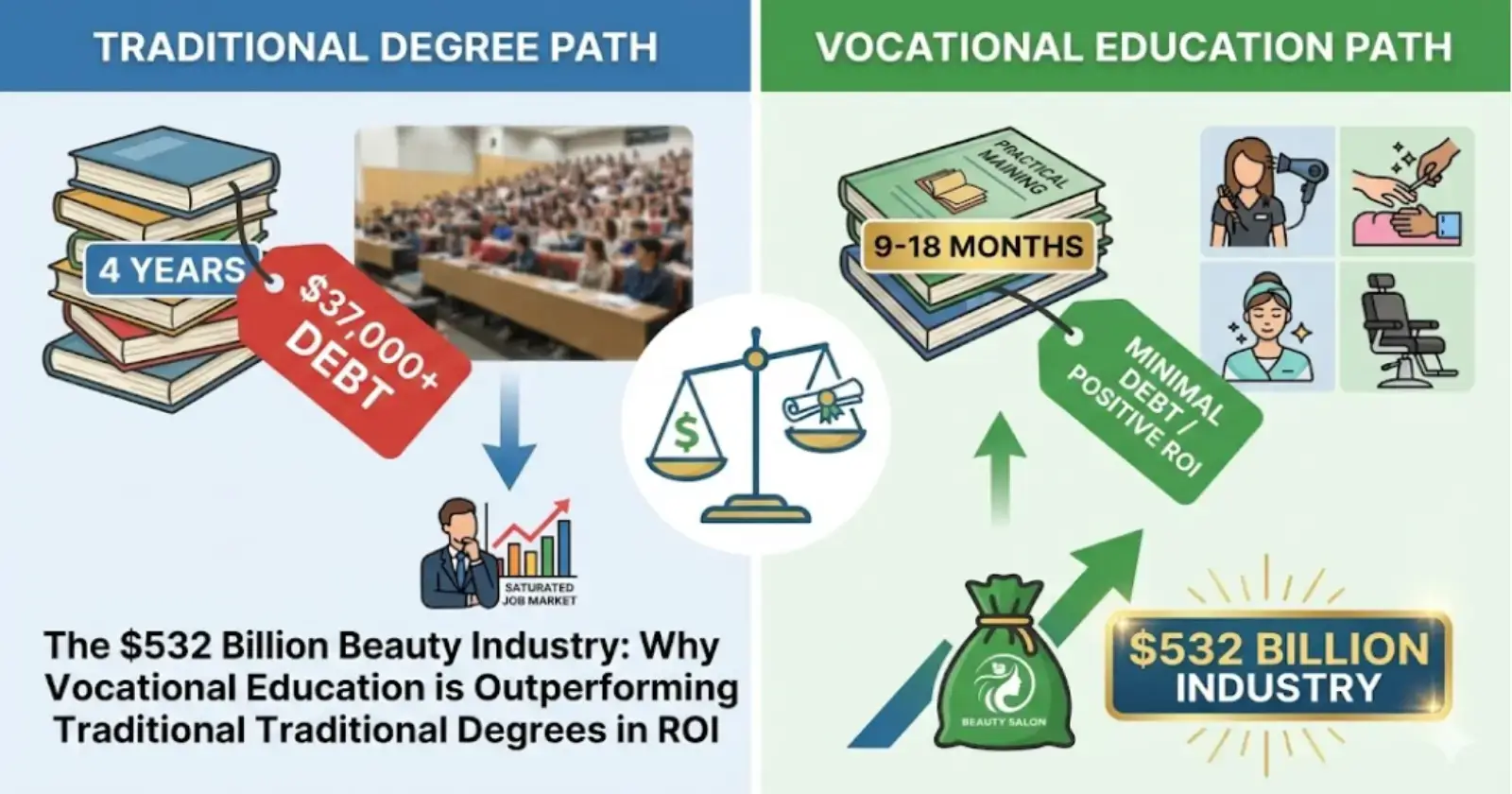
The average four-year college graduate carries $37,000 in student loan debt and faces an increasingly saturated job market. Meanwhile, vocational training programs—particularly in beauty and wellness—are producing graduates who enter the workforce with minimal debt, immediate employment, and positive cash flow within months of completion.
Let’s run the numbers that financial advisors conveniently ignore:
➤ Traditional College Path
- 4 years of education
- Average cost: $100,000-$200,000+ (private universities)
- Time to positive ROI: 8-15 years
- Student loan payments: $400-$800/month for 10-20 years
- Market saturation: High (especially in liberal arts)
➤ Vocational Training Path
- 9-18 months of education
- Average cost: $15,000-$25,000
- Time to positive ROI: 1-3 years
- Minimal or zero debt
- Market demand: Consistently strong
The Beauty Industry’s Economic Resilience
Here’s what makes this particularly interesting from a macroeconomic perspective: The global beauty and wellness industry generates over $532 billion annually and has demonstrated remarkable recession resistance. Even during the 2008 financial crisis and 2020 pandemic, demand for personal care services remained relatively stable.
Why? Because unlike discretionary luxury purchases, personal grooming occupies a unique economic position—it’s both a psychological necessity and a professional requirement for many workers. People will skip expensive vacations, but they still need haircuts.
The Skills Gap Creating Opportunity
While universities pump out graduates with degrees in oversaturated fields, skilled trades face significant labor shortages. The beauty industry alone projects needing 200,000+ new professionals over the next decade to replace retiring workers and meet growing demand.
This supply-demand imbalance creates pricing power for skilled practitioners. Experienced professionals with established clientele can command premium rates, and the best performers build six-figure incomes—without the MBA debt.
The Gig Economy Advantage
Vocational beauty professionals possess something most corporate workers don’t: true economic independence. They can:
- Set their own prices
- Choose their clients
- Work as independent contractors (avoiding employment overhead)
- Build portable businesses that follow them anywhere
- Scale income through multiple revenue streams (services, products, education)
This level of autonomy is increasingly valuable in an economy where corporate “job security” is essentially fictional.
Age Arbitrage in Career Training
Here’s an interesting arbitrage opportunity most people miss: While traditional education demands prime earning years (ages 18-22), vocational training accepts students at any age. This creates several strategic advantages:
For young people: Enter the workforce at 18-19 instead of 22-23, gaining 4-5 years of earning and compounding advantage. Those who understand compound interest recognize this head start’s massive long-term value.
For career changers: Adults in their 30s-50s facing corporate obsolescence can retrain in under two years, avoiding ageism that plagues traditional hiring while building businesses immune to age discrimination.
The question of minimum age requirements for specialized training becomes relevant here—states typically allow entry as young as 16, creating even earlier economic independence opportunities.
The Inflation Hedge Nobody Discusses
As inflation erodes purchasing power and wages struggle to keep pace, service-based businesses maintain unique advantages. Beauty professionals can adjust pricing in real-time to match inflation, unlike salaried workers locked into annual review cycles.
Additionally, the skills themselves are inflation-resistant. Unlike technology certifications that obsolete rapidly, fundamental beauty techniques remain valuable across decades, requiring only minor updates for trends.
The Real Cost of “Free” College Promises
Political promises of free college sound appealing until you examine the opportunity cost. Even if tuition becomes “free,” students still face:
- 4 years of lost earning potential ($120,000-$160,000 in foregone wages)
- Living expenses during those years ($40,000-$80,000)
- Delayed family formation and major life purchases
- Entry into oversaturated job markets
- Careers vulnerable to outsourcing and automation
Vocational professionals skip these costs entirely while building income-generating skills AI can’t replicate. Robots won’t be cutting hair or providing personalized esthetic consultations anytime soon.
Market Signals Everyone Ignores
The market is clearly signaling demand for skilled trades. Entry-level positions offer immediate employment, many locations face worker shortages, and wages are rising faster in trades than many white-collar fields. Yet societal bias toward four-year degrees persists, driven by universities’ marketing budgets and outdated status signaling.
Smart economic actors ignore social pressure and follow market signals. Right now, those signals favor practical skills training over expensive generalist degrees.
The Bottom Line
This isn’t about dismissing higher education entirely—certain careers (engineering, medicine, law) require traditional degrees. But for individuals evaluating pure economic return, vocational training offers superior ROI in less time with dramatically lower risk.
In an economy increasingly characterized by uncertainty, the ability to generate income independently, adjust to market conditions rapidly, and avoid crushing debt loads represents genuine economic security. That’s something no degree from a prestigious university can guarantee.
The beauty industry’s $532 billion market cap, demographic tailwinds (aging population requiring more services), and recession resistance make it a compelling sector for human capital investment. Yet most financial advisors and career counselors never mention it.
Perhaps it’s time to stop following conventional wisdom and start following the numbers.

1 Comment
Nice post. I learn something totally new and challenging on websites