


Ever wondered how large numbers are simplified so easily in mathematics? That’s where logarithms come in. They play a key role in breaking down complex calculations into simpler steps, making it easier to work with very large or very small values. Log₁₀, in particular, is one of the most commonly used logarithms for this purpose.
Even though log₁₀ is meant to simplify calculations, it often feels confusing at first because of the formulas and steps involved. But once you understand the basic idea behind it, everything starts to fall into place.
With the right approach, log₁₀ becomes much easier to grasp and apply. Whether you’re a student learning the concept for the first time or someone revisiting the basics, it has practical applications across fields like science, engineering, and data analysis.
In this blog, we’ll break down what log₁₀ is, its formula, and how it works in a simple and clear way.
What is log₁₀?
Log₁₀ is a simple math tool that flips the exponential around. It is commonly known as log base 10 and pops up in every concept from advanced science to every calculator.
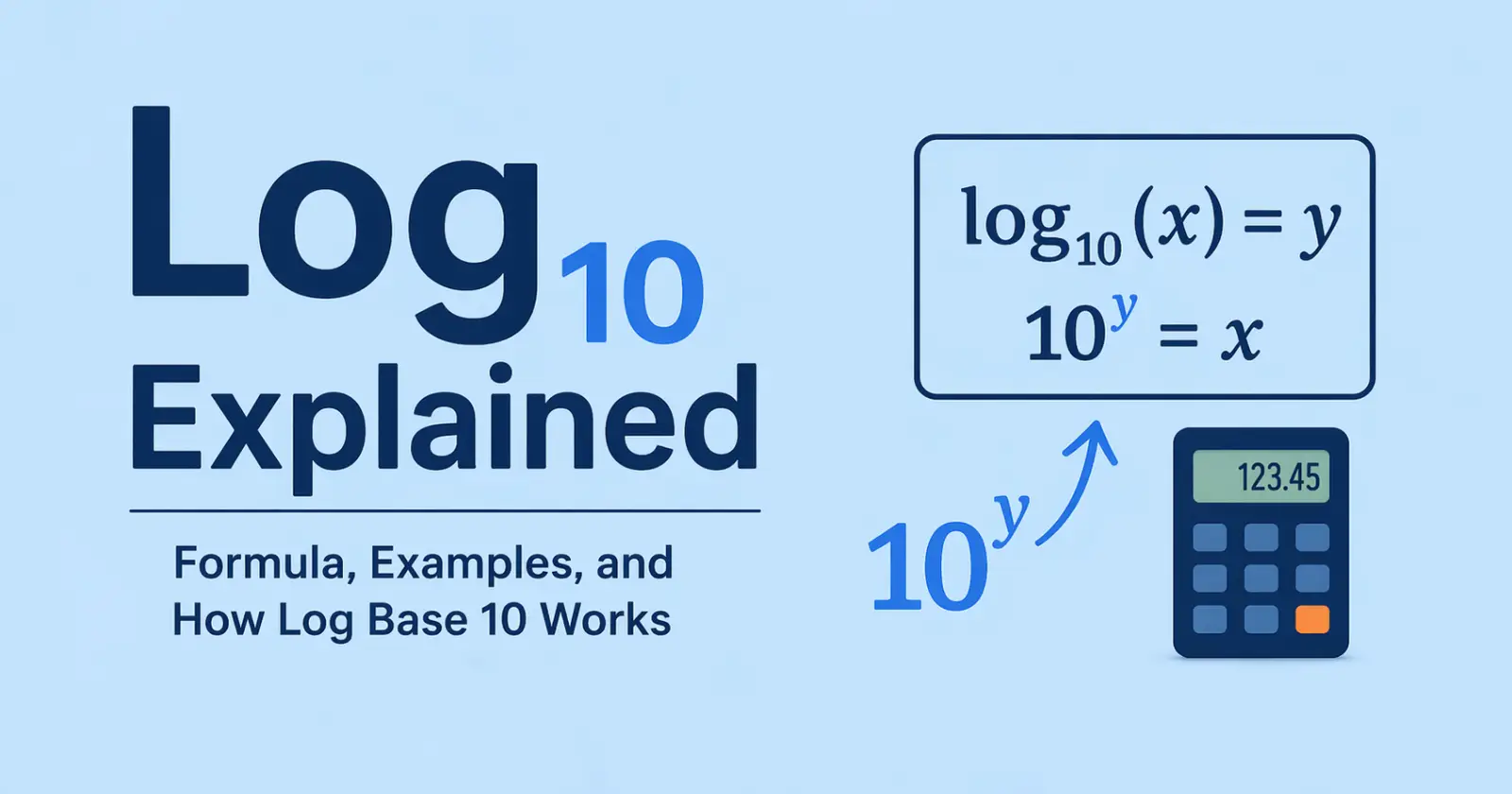
For example, when you see log₁₀(x) = y, it means the value of 10 to the power of y is x. In the log terms, the x values always remain positive, as the logs of zeros or negatives don’t work in basic real math. When someone asks, what are the exponential turns of 10 into 100? The answer is 3, as 10 to the power of 2 is 100. Numbers over 1 give positive logs, like log10(1000) = 3. Numbers between 0 and 1 give negatives, such as log10(0.1) = -1.
In the mathematics log concept, base 10 fits the decimal system perfectly and ensures exact numbers despite the larger number deals. In historical terms, before the age of computers, many people used log tables to multiply huge numbers by turning multiplication into addition. In today’s world, the log calculation is done with a simple tab on calculators.
Log10 Formula
Log₁₀ is a simple tool in mathematical calculation, whereas y = log₁₀(x) when the 10th power of y = x. To resolve it without the calculator, the user can use properties of logarithms.
Properties of logarithms
For products, log10(a×b)=log10(a)+log10(b)
For power, log₁₀ (a power of n) = n × log₁₀(a)
By following these rules, the users can easily identify the issues in calculation and quickly resolve them. For a change of basis, you need log₁₀(x) = In(x)/In(10), where In is the natural log. In Excel and Python coding, the user can type log10(x) on the system for instant calculation results.
Sample Examples
log10(10) = 1, as the 10th power of 1 = 10 and the log10(100) = 2. The user needs to remember that log10(1) is always 0, while 10^10 is 1. By understanding and memorizing the basic facts, users can easily navigate through larger numbers and calculate them instantly.
For decimal calculation, log10(0.01) = -1, as the 10th power of -2 is 0.01. When you want log₁₀(50), log₁₀(5 × 10) = log₁₀(5) + log₁₀(10). log₁₀(5) is 0.6990, and with the additional one, it equals 1.6990.
Table for Log Values
Here is the quick table guidance for the user to memorize the values.
| Number | log₁₀ value | Check |
| 10 | 1 | 10^1=10 |
| 100 | 2 | 10^2=100 |
| 0.1 | -1 | 10⁻¹ = 0.1 |
How log₁₀ Works: Step-by-Step Usage
Along with mathematics concepts, log₁₀ shines out in science, data analysis, measurement, and decibels for sounds. Each 10 dB in sound means a 10 times louder noise, which is calculated as 10 log₁₀(I/I₀).
In the science procedure, log₁₀ is used to check the pH values. For example, to calculate the acidity value, pH = -log₁₀([H⁺]), where pH 7 means the neutral value of the product.
In the Richter scale for quakes, each point in log is 10 times stronger.
The log is used to calculate the returns for steady growth views such as log (P2/P). In data science, log values use features to normalize big ranges, while in audio engineering, the engineers tweak volume in dB. The log10 values in various fields give significant help in simplifying the concept and making a quick calculation process.
Common Mistakes to Avoid in Using log₁₀
Though log₁₀ gives a supportive calculation in various factors, many understand the concept and use it the wrong way. The users need to watch out for log10(0) = undefined. Using negative values on undefined values can change the complete algorithm and cause issues.
Avoid mixing log₁₀ with In(x), which holds base e ~ 2.718. So always ensure to check the values of x > 0 before making the calculation. Users need to always practice their strategic calculation and use properties to simplify the calculation process.
Final Takeaway
From advanced technology to everyday calculations, log₁₀ plays an important role. It helps break down complex problems into simpler steps, making calculations more accurate and easier to handle. It is widely used in fields like data science, climate studies, finance, and engineering, where working with large numbers and exponential values is common.
Once you understand the basics, log₁₀ becomes a powerful tool rather than a confusing concept. Practice regularly, and you’ll find it much easier to apply in both academic and real-world scenarios.
Read Also – How to Calculate Percentage
