


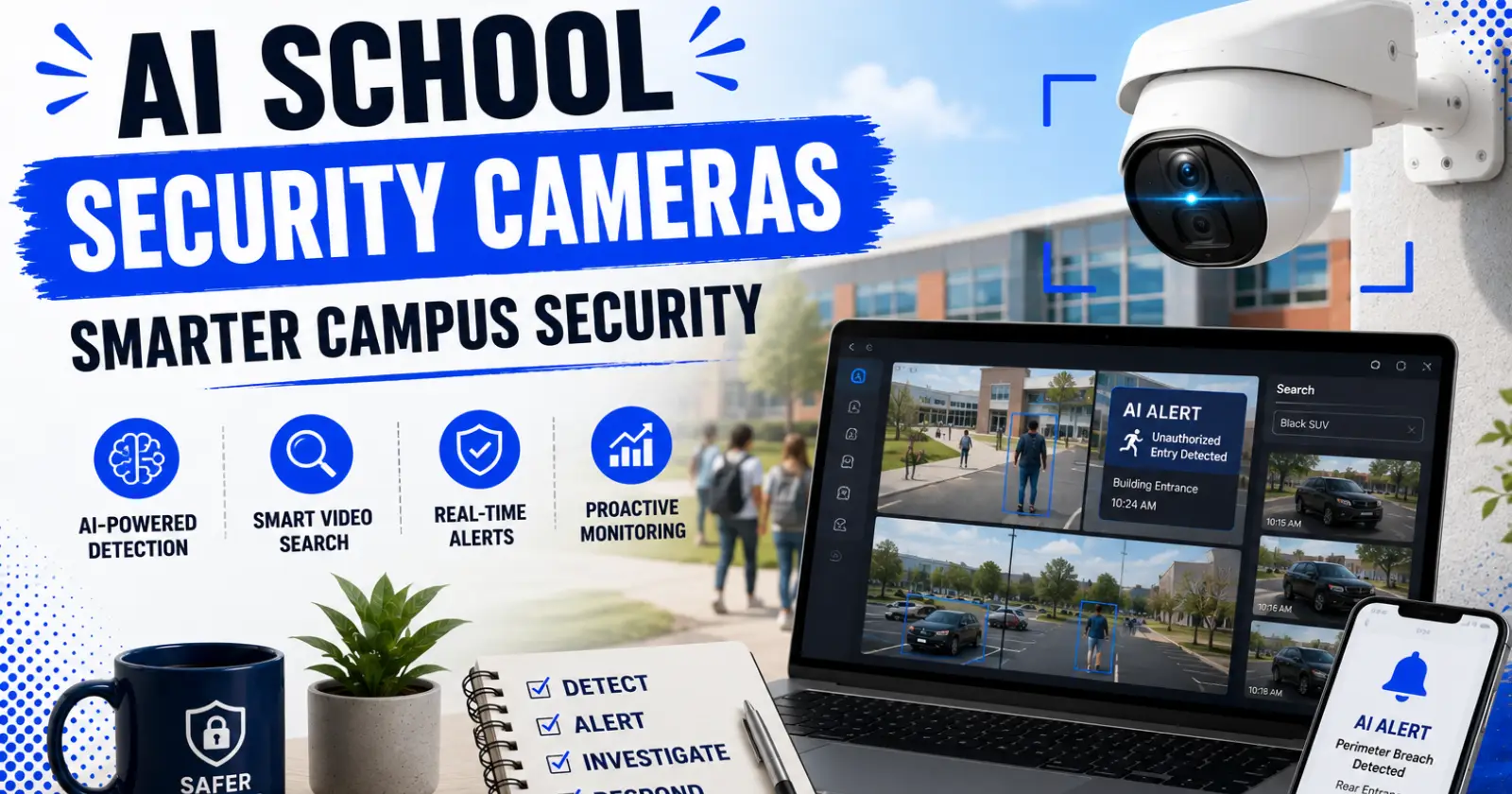
Security cameras are already standard equipment in American schools. According to the National Center for Education Statistics (NCES), 93% of U.S. public schools used security cameras in 2021–22, up from just 61% in 2009–10. Among secondary and high schools, adoption reached approximately 97%.
But having cameras and having intelligent security are two different things.
A traditional CCTV system can show administrators what happened in a hallway yesterday. In 2026, schools increasingly need technology that can help them find a specific person or vehicle quickly, flag potential threats, connect events across cameras, and give security teams useful information while an incident is still unfolding.
That distinction matters when campuses can have dozens or hundreds of cameras. One real-world example is Daleville Community Schools, which serves around 1,000 students and operates more than 100 security cameras. At that scale, expecting staff to watch every feed continuously is unrealistic.
The next generation of school security cameras is therefore less about adding screens and more about making existing video useful. Here is how AI is changing campus surveillance in 2026.
1. Cameras Are Moving From Passive Recording to Intelligent Alerts
For decades, the basic job of CCTV was straightforward: capture footage and save it. If a fight, theft, trespassing incident, or other event occurred, administrators could return to the recording afterward.
That model remains useful for evidence, but it has a fundamental limitation. A recording cannot improve an immediate response if nobody knows an important event is happening.
AI-assisted surveillance changes the workflow by analyzing video and drawing attention to predefined events. Depending on the system and school policy, alerts can help security personnel focus on activity involving restricted locations, people or vehicles of interest, or other defined security conditions.
This is particularly valuable on larger campuses. Rather than asking an employee to divide attention among dozens of live feeds, the technology can help narrow attention to the cameras associated with an event.
Modern platforms illustrate how this works in practice. Coram, for example, can add AI capabilities to existing school security cameras rather than requiring a school to replace its entire IP camera installation. Its school platform supports real-time alerts, tracking of people and vehicles of interest, license plate alerts, firearm detection, and integration with access control and environmental sensors. Coram also says searches can be run across recorded footage using descriptions such as a “black SUV,” helping staff locate relevant video without manually reviewing long recordings.
For schools working with limited security personnel, the practical benefit is straightforward: the camera system helps direct human attention instead of simply generating more footage for humans to watch.
2. Natural-Language Video Search Can Turn Hours of Footage Into a Faster Investigation
Finding an incident is one of the least glamorous but most important parts of school surveillance.
Consider a common scenario. A vehicle enters a campus parking lot in the morning, an incident is reported later, and administrators need to determine when the vehicle arrived, where it went, and whether cameras captured the people associated with it.
With conventional CCTV, someone may have to identify likely cameras, select time windows, play recordings, fast-forward, rewind, and repeat the process.
AI-powered search can reduce that manual work by indexing what appears in footage. Instead of treating recorded video as one long timeline, newer systems can make it searchable using characteristics such as objects, appearances, locations, or vehicles.
That matters as camera counts increase. A school with 100 cameras produces 2,400 camera-hours of footage every 24 hours if all cameras record continuously. No security office can manually review that volume as a routine practice.
Smart search does not make investigations automatic, nor does it remove the need to verify what the system returns. What it can do is dramatically narrow the amount of footage a person needs to examine. That makes surveillance more useful for investigating vandalism, unauthorized entry, missing property, parking incidents, and other everyday campus concerns.
3. AI Can Help Schools Connect Activity Across a Large Campus
A single camera rarely tells the entire story.
Someone entering through a parking area may later appear near an academic building, hallway, cafeteria, or exit. Traditional CCTV can capture all of those moments while still leaving staff to manually piece them together.
AI-assisted systems can make that process more manageable by helping locate a person or vehicle across multiple cameras based on searchable visual characteristics.
This is increasingly relevant because surveillance has become widespread across school levels. NCES reported camera use in about 91% of elementary schools, 96% of middle schools, and 97% of secondary/high schools in 2021–22.
The challenge in 2026 is therefore not simply camera availability. It is making hundreds of separate viewpoints function more like a coordinated security network.
For example, if staff are looking for a particular vehicle after an incident, an intelligent system may help locate appearances of that vehicle across entrances and parking areas. Security personnel can then use those results to establish a timeline instead of opening cameras one by one.
The same principle can support routine incidents. Administrators investigating property damage, unauthorized visitors, or a student altercation can begin with a narrower set of relevant footage.
Read Also – Private School Admissions Explained
4. Smarter Cameras Can Strengthen Perimeter and Entry Monitoring
Schools have invested heavily in controlling who can enter their buildings. NCES data shows 97% of public schools controlled access to buildings during school hours in 2021–22, while the same percentage required visitors to sign or check in and wear badges. However, controlled access to school grounds was much less common, at about 61%.
That difference highlights an important security gap.
A school can have a well-managed front entrance while still needing visibility across parking lots, gates, athletic areas, loading zones, and other approaches to the building.
AI can make cameras in these areas more useful. License plate recognition, vehicle search, and alerts associated with people or vehicles of interest can give staff additional situational awareness before someone reaches a main building.
The technology should support, rather than replace, established visitor management, access-control procedures, staff judgment, and emergency plans. A camera alert is a piece of information, not proof of harmful intent.
Used appropriately, however, intelligent perimeter monitoring can give schools something conventional CCTV struggles to provide: earlier awareness of activity approaching the campus rather than evidence discovered afterward.
5. AI Is Making Large Camera Networks Easier to Manage
More cameras do not automatically create better security.
In fact, expanding a traditional CCTV network can create a new problem. Every additional camera adds another feed that someone may need to monitor, another recording to search, and another source of footage to manage during an investigation.
Real school deployments show how quickly this can scale. Coram reports that Charlton County Schools serves 1,695 students across four schools and uses AI across hundreds of cameras, while Hart Public Schools serves more than 1,300 students across four schools on one campus.
AI can help turn these large networks into something staff can actually use by prioritizing alerts, providing centralized views, and improving search.
A useful smart-camera setup should help administrators answer practical questions quickly:
- Which camera captured the relevant event?
- When did the person or vehicle first appear?
- Did the subject appear on another camera?
- Who on the security team needs to see the footage?
- Can the relevant clip be shared without providing access to unrelated recordings?
These may sound like simple tasks, but reducing the time required to answer them can make a major difference during a fast-moving investigation.
6. The Biggest Change Is From Reactive to Proactive Campus Monitoring
The real transformation is not that cameras suddenly have AI. It is that schools can begin using video differently.
Traditional CCTV is predominantly reactive. An incident occurs, staff learns about it, and someone retrieves the recording. Smarter systems introduce the possibility of a more proactive workflow in which defined events can generate alerts and relevant footage can be located quickly.
That does not mean AI can predict every threat or guarantee school safety. School security involves people, policies, building design, emergency planning, communication, access control, training, and coordination with local authorities. Cameras are only one component.
The statistics reinforce that broader approach. In addition to 93% using cameras, about 65% of public schools reported having a threat assessment team in 2021–22, while 62% had structured anonymous threat-reporting systems, up from 36% in 2009–10.
The direction is clear. Schools are building layered safety strategies, and smarter video can become another source of timely information within that strategy.
Key Takeaways
- School camera adoption rose from 61% in 2009–10 to 93% in 2021–22, showing how deeply surveillance has become embedded in campus safety.
- AI is shifting cameras from passive recording toward intelligent alerts and faster investigation.
- Searchable video can be particularly valuable when a campus operates dozens or hundreds of cameras.
- Vehicle and person-of-interest tools can improve situational awareness around entrances, parking areas, and other campus zones.
- AI should support trained staff and established safety procedures, not replace human judgment.
- For schools that already have IP cameras, upgrading the intelligence behind existing infrastructure may be more practical than simply installing more cameras.
FAQs
1. How are AI school security cameras different from traditional CCTV?
Traditional CCTV primarily captures and stores video. AI-enabled systems can additionally analyze footage, generate defined alerts, and make recordings easier to search. The goal is to help staff find relevant information faster rather than requiring continuous manual monitoring.
2. Can schools add AI without replacing existing cameras?
It depends on the platform and the existing hardware. Some systems are designed to add cloud and AI capabilities to compatible IP camera networks, which can reduce the need for a complete camera replacement.
3. Can AI help find a person or vehicle in recorded school footage?
Yes, some modern platforms index visual information so authorized users can search for people or vehicles using appearance-related characteristics. Results still need to be reviewed by a person before decisions are made.
4. Are more cameras always better for school security?
Not necessarily. A large camera network is useful only if staff can manage and retrieve information from it effectively. Search, alerts, camera placement, policies, training, and integration with the school’s wider safety plan can matter as much as the number of cameras.
5. Will AI replace school security personnel?
No. AI is better understood as an assistance layer. It can help prioritize information and reduce manual video review, while people remain responsible for evaluating context and deciding how to respond.
Conclusion
School surveillance has changed dramatically. Camera adoption in U.S. public schools has risen by more than 30 percentage points since 2009–10, but the more important change in 2026 is what schools can do with the footage those cameras produce.
AI-powered search, intelligent alerts, vehicle tracking, and centralized monitoring can make existing video networks considerably more useful. Instead of treating surveillance as an archive that is opened after an incident, schools can use it as one part of a broader system for situational awareness and faster investigation.
The smartest upgrade, therefore, may not be adding another hundred cameras. It may be making the cameras a school already has easier to search, manage, and act on.
Read Also – Best AI Presentation Makers for School Use
