


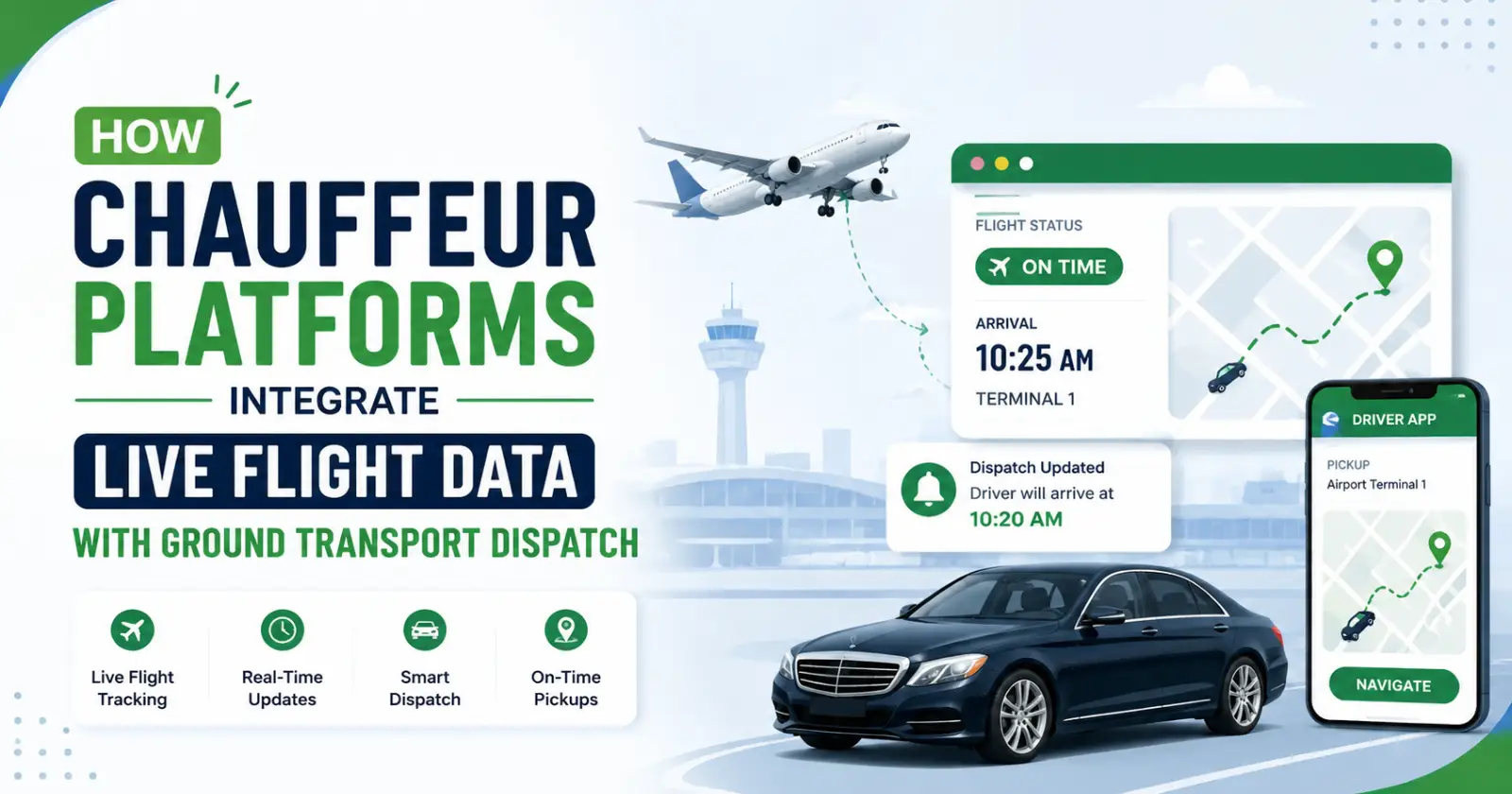
When a flight lands 40 minutes early, a standard car booking becomes a problem. The driver is. Not there yet, circling the airport or parked in a fee-accumulating zone waiting for a passenger who has already cleared arrivals. This is not a situation. It happens every day to ground transport providers handling airport transfers.
Solving this problem requires more than intentions. It requires an integration between aviation data systems and dispatch software that updates in real time and triggers automated responses without human intervention.
This article explains how that integration actually works, what data sources are involved, and why it is one of the complex logistics challenges in the passenger transport technology stack.
The Core Problem
The main problem is that chauffeur booking systems operate on fixed schedules. A passenger books a pickup for 3:00 PM, a driver is assigned and dispatched accordingly. The system has no awareness of whether the flight is on time, delayed, or diverted. Any adjustment requires a phone call. From a passenger from the airline or from someone monitoring a flight tracking tool manually.
At volumes, this is manageable. When you have a lot of airport transfers at the same time, it breaks down completely. A fleet handling dozens of airport transfers simultaneously cannot rely on monitoring. Even a single luxury car with driver in dubai booking can go wrong. A passenger waits curbside while a driver circles. Exposes the weakness of schedule-dependent dispatch systems.
Where the Flight Data Comes From
Live flight data is not one feed. It comes from sources and has to be put together properly before it can be used for transport.
ADS-B (Automatic Dependent Surveillance–Broadcast) is the source of raw data.
Aircraft continuously transmit their GPS location, altitude, speed, and ID code via a device. Ground receivers catch these signals. Send them to networks that gather the information. Companies such as FlightAware, FlightRadar24, and OAG gather. Share this data through APIs.
Airport FIDS (Flight Information Display Systems) provide another source of data. These are the boards that show arrivals and departures run by airport authorities.
The data from these boards includes gate numbers, baggage carousel numbers, and updates on flight status, which ADS-B does not provide. Having this data helps a dispatch system know not only when a plane lands but also which terminal it arrives at and which carousel is assigned. Both are critical for figuring out where a driver should go.
Airline operational systems are a source usually accessed through special messaging networks like SITA or ARINC used in aviation. These networks carry data such as pushback times, how long taxiing takes, and gate hold information. Fewer transport platforms have access to this source. It is used in big enterprise integrations.
How the Dispatch Engine Consumes Flight Data
When flight data gets to the platform, the dispatch engine needs to know what to do with it. This is where the system gets specific to each platform. The basic idea is the same everywhere.
When someone books a flight, the system keeps an eye on that flight number. It checks the aviation API every minute, usually between two and five minutes, and compares the arrival time to what it was when the booking was made.
If the flight is going to be more than fifteen minutes late or more than ten minutes early, the dispatch engine figures out the best time for the driver to leave again. It looks at real-time traffic, where the driver sees how long it takes to get from the plane to the arrivals area.
A service like a luxury car with a driver in Dubai needs this kind of precision behind the scenes. It makes sure that the flight is monitored, the driver is in place, and the timing of the arrivals is all coordinated automatically without needing to make phone calls.
Driver Notification and Re-Dispatch Logic
When the dispatch engine figures out the time, it tells the driver’s app what to do next. Depending on how the platform’s set up, this might be a message with a new pickup time, or it might update the route in the driver’s navigation, or it might do both.
The system also has to deal with what happens if a driver has already left for the airport. Then the flight is delayed. In this case, the platform has to decide whether to have the driver wait somewhere, send them a way for a little while, or give the booking to a different driver who is closer.
Drivers waiting at airports add another layer. Most big airports have areas for commercial vehicles to wait, and there are rules about how long they can stay before they have to move.
Baggage Claim and Last-Mile Coordination
The last problem with getting people from the airport to their place is the baggage claim area. A person who has gone through immigration but is still waiting for their bags is not ready to be picked up. If we send a driver to the curb before they have their bags, the driver will just have to wait and might even get in trouble for stopping in a no-stop zone.
Some companies fix this problem by having an app that the person can use to tell us when they have their bags and are heading out. When they do this, we can send the driver to pick them up. Other companies use a kind of fence around the airport that can tell when the person is leaving the baggage claim area, and then we send the driver.
Why This Integration Is Technically Non-Trivial
The parts that make this system work, like getting information from planes looking at the airport screens, checking traffic, guessing when planes will arrive, telling drivers where to go, and using the fence, are all things that people understand. The hard part is putting all these things together so that they work well in the world.
The information from the airport is not always available. Traffic information can be old and not helpful when things are changing fast. Drivers might lose their connection to the internet when they are in parking garages. People’s devices are all different. It can cause problems. If we rely on one source of information and do not have a backup plan, the system will fail a lot. So we have to make sure each part of the system has a backup and can still work even if some information is not available.
Conclusion
Flight-integrated dispatch is not a feature; it is something that every chauffeur platform needs to have to work properly. This means putting together aviation data, real-time traffic updates, and ways for drivers to communicate.
As people who use these services want to be picked up on time and know what is going on, the platforms that can make all of this work together smoothly are the ones that can keep their promise to get people where they need to go without any hassle. It is about getting the vehicle to the passenger when they need it.
Read Also – Smart Travel Tech Tools That Make International Trips Smoother
