


Time is frequently associated with people’s daily lives as they use calendars, planning, and scheduling based on their observations regarding their daily activities. The problem of how many minutes in a year looks rather obvious, but it can be used to establish a relationship between days, hours, and minutes that make up a logical framework applied in the field of education and planning. The concept provides the means to understand the annual duration in a concise manner that can be useful in academic research and practical application.
Time Units in a Year
The measurement of time per year starts with simple measures like seconds, minutes, hours, and days, which are part of a well- structured system in calendar systems used internationally. The progression from the small measure to the larger is very clear in each case, making it easy to convert large periods is very clear in each case, making it easy to convert large periods of time into measurements.
Minutes act as the central unit in this system since they connect hours and days in a consistent format. This structure supports accurate interpretation of yearly duration across academic learning, scientific observation, and everyday scheduling activities in organized systems.
Standard Calculation for Regular Year
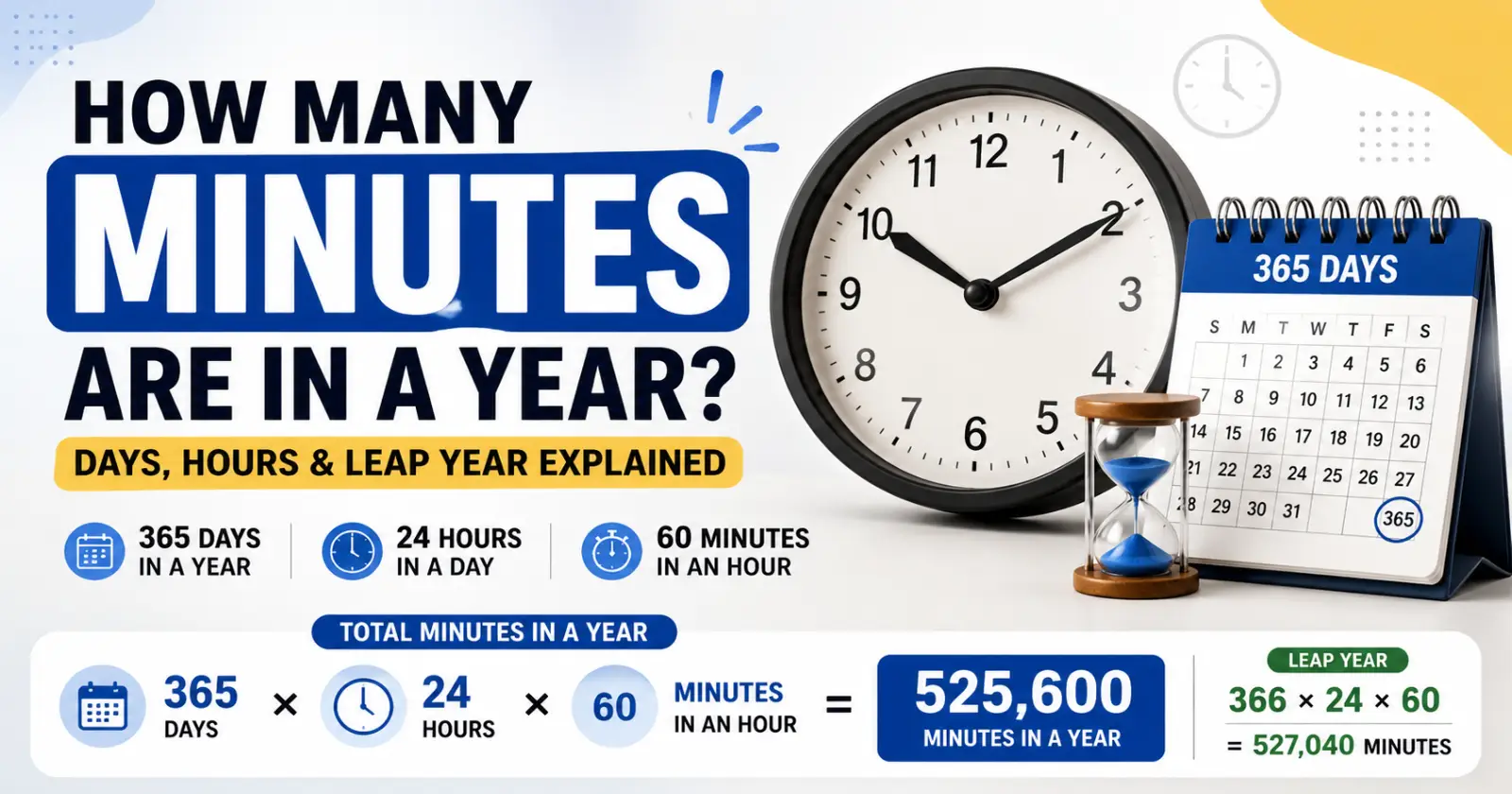
A normal year has a constant calendar value of 365 days, which provides the basis for converting a period of a year into smaller units to facilitate easy calculation in a time system. The question of how many minutes in a year can be understood using a simple conversion in a time system to facilitate easy calculation. In one day, there are 24 hours, while in each hour there are 60 minutes, forming a constant conversation factor that can be used in mathematical analysis. The total calculation will be 365 x 24 x 60 = 525,600 minutes. This is the total number of minutes in a year.
Read Also – How Many Seconds In A Year
Breaking Hours into Minutes Structure
Hours function as an intermediate unit that connects days with minutes in a structured time conversion system used in both academic and practical applications. One hour contains 60 minutes. Forming a fixed ratio that remains constant across all calendar systems. This relationship allows a large time period to be broken into smaller, measurable units for clarity in calculations. When yearly values are expanded through this conversion, each hour contributes directly to the total yearly minutes. This method supports a consistent understanding of time flow across schedules, timelines, and long-duration planning activities.
Daily Cycle and Yearly Accumulation
Each day is made up of 24 hours, which makes up the cycle that determines how we measure time on an annual basis using our structured calendars globally. Every day provides a consistent number of hours and minutes. Hence, we have a pattern of accumulation throughout the year. It gives us the opportunity to accumulate throughout the year. It gives us the opportunity to calculate the total number of hours in a year by multiplying the number of hours in each day by all 365 days in a year.
Read Also – How Many Hours Are In A Week
Leap Year Variation in Total Minutes
Leap years introduce an additional day into the calendar cycle, adjusting yearly time measurement to match Earth’s orbital pattern around the Sun in precise alignment. This extra day increases total yearly duration and affects minute calculations across the full year. The calculation becomes 366 x 24 x 60 = 527, 040 minutes, representing the total minutes in a leap year. This adjustment ensures calendar accuracy over long periods and maintains consistency in scientific measurement, scheduling systems, and chronological studies that depend on precise yearly time values.
Practical Importance of Yearly Minute Calculation
Yearly minute calculations play an important role in planning systems used in education, business, and research environments where time tracking remains essential for structured organization. These calculations help in dividing long-term goals into measurable time units that support productivity and scheduling accuracy.
Exploring total yearly minutes allows clearer forecasting of work duration, study plans, and project timelines across various fields. It improves awareness of how time accumulates over extended periods and supports efficient allocation of tasks in both personal and professional time management.
To Wrap Up
Knowledge about the way time is measured each year will give a clear insight into the process through which small units of time form a comprehensive calendar structure that is applied in day-to- day life. The question, How many minutes in a year, provides a clear idea of the days, hours, and minutes that form a comprehensible numerical representation for proper time scheduling and calculations. In a normal year, there are 525,600 minutes, while in a leap year, there are 527, 040 minutes.
Read Also – How Many Hours In A Year
