


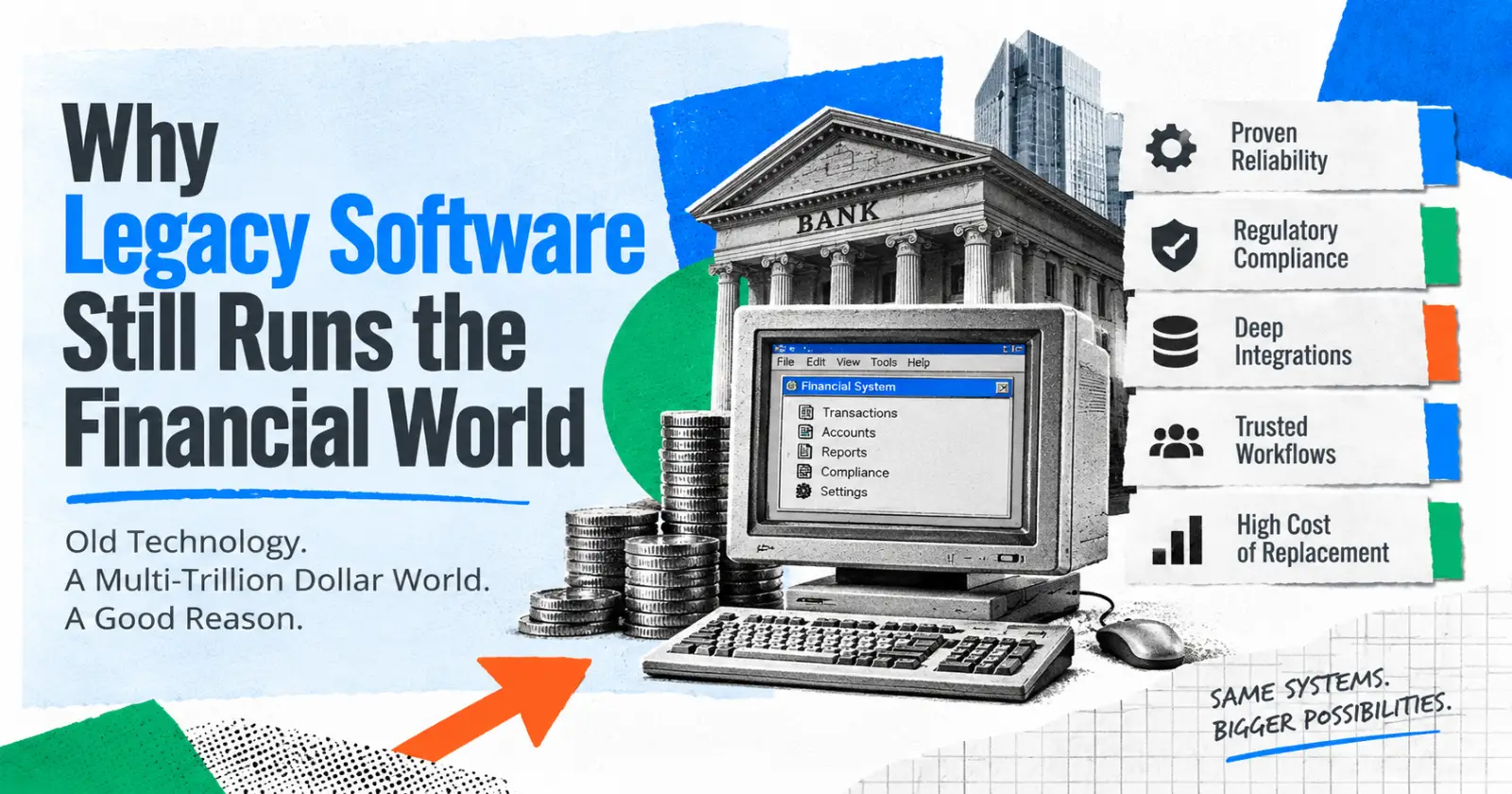
Walk into a bank, trading firm, insurance company, or accounting department, and there is a good chance you will find software that looks as if it belongs on a computer from another era. The interface might feature tiny buttons, grey menus, dated fonts, and terminology that makes perfect sense to someone who has worked there for 20 years. To everyone else, it looks overdue for retirement. Yet that old software often sits underneath processes involving millions of dollars, and there is a reason for this.
Financial Software Earns Its Longevity
Financial institutions treat software differently because their systems sit close to money, regulation, reporting, and customer records. A program that has processed transactions reliably for years has accumulated proof, which is really valuable in this context, because every calculation has been tested. Every major bug has been discovered. Employees know how it behaves. Other systems have been built around it, and replacing such software introduces uncertainty. A new application might offer a beautiful interface and faster features, yet migration creates opportunities for data errors, calculation differences, compatibility problems, training costs, and operational disruption. That equation explains why old Windows applications survive far beyond their expected lifespan. The software itself is only part of the story, but the larger system surrounding it is the real investment.
Compatibility Often Beats Fashion
Modern software developers regularly work with APIs, cloud platforms, containers, and automated deployment pipelines. Legacy financial environments frequently involve older databases, proprietary formats, specialised hardware, and Windows components developed decades ago. Those technologies persist because changing one component often affects several others. Suppose an accounting application exports data in a format used by another internal system. That second system feeds a reporting database, which supplies figures to a compliance tool. The original application might look obsolete, but removing it requires rebuilding an entire chain, and this is why companies sometimes keep an old application running while placing newer technology around it.
Reliability Has a Financial Value
In finance, downtime carries a price. A retail website being unavailable for an hour is frustrating. A system used for payments, trading, settlements, payroll, or regulatory reporting going offline creates operational problems that spread rapidly. Legacy software has one major advantage here, which is predictability. IT teams often know exactly which operating system version supports it, which database it requires, which permissions it needs, and which patches require caution. That knowledge becomes institutional memory. A useful lesson follows for anyone choosing business software: judge maturity alongside features. Ask how long the product has existed, how widely it is deployed, how updates are handled, and what happens when something breaks.
Traders Still Value Tools that Simply Work
The same principle appears in trading software. Platforms such as MetaTrader 4, offer modern trading capabilities while retaining familiar desktop workflows that traders understand quickly. Someone comparing trading platforms therefore has practical questions beyond appearance: Which markets are supported? How does order execution work? What analytical tools are included? How does the platform handle automated strategies? Those questions matter because software becomes useful when it fits an established workflow.
The Hidden Cost of Replacing Old Systems
The biggest expense in legacy replacement often arrives after the purchase order. Employees require training. Historical data requires conversion. Integrations require testing. Security teams require new controls. Compliance departments require documentation. Customers might encounter changes they never requested. Then comes the uncomfortable discovery which is that some old features existed only because employees had built workarounds around the original system. Before replacing legacy software, companies therefore benefit from mapping the entire workflow. Identify every input, output, database, report, integration, user group, and manual step. Record the exceptions too. The strange spreadsheet someone maintains every Friday could be part of the real system. That exercise frequently reveals why an apparently simple replacement project takes years.
Old Software Survives Because Institutions Remember
The financial world has little patience for unnecessary risk, and that mindset explains the persistence of aging Windows software. Legacy applications survive when their reliability, integrations, data history, and institutional knowledge outweigh the benefits of replacement. For businesses, the practical takeaway is to never judge an old system by its interface alone. Ask what depends on it. Ask what evidence proves it works. Ask what breaks when it disappears. And ask whether the proposed replacement solves a genuine business problem. Sometimes the most valuable piece of software in a company is the one everyone complains about, yet nobody dares switch off.
